You’ve been in the pain-relief aisle, and you know how it feels: three different product categories sitting on the same shelf, all claiming to help sore muscles, and nothing on the box that actually explains how they work differently. A lidocaine patch — a thin adhesive strip that delivers a numbing anesthetic, meaning a substance that temporarily blocks nerve signals — does something fundamentally different from a menthol patch, which creates a cooling sensation to distract from pain, and from a heat wrap, which uses sustained warmth to relax muscle tissue and increase blood flow. Those differences matter a great deal when you’re choosing for a specific situation: a pulled hip flexor the day before a race, chronic lower-back tightness from long hours at a desk, or acute soreness after a heavy training block. This guide lays out the three formats side by side, names the trade-offs explicitly, and ends with clear decision rules so you can pick confidently rather than by default.
How Each Format Actually Works — and Why It Matters
Before you choose a brand, you need to choose a mechanism. This is the format-first principle: the delivery vehicle and active ingredient determine what the product can and cannot do. Getting this wrong means spending money on the wrong tool.
Lidocaine Patches: Local Anesthesia
Lidocaine patches work through local anesthesia. The active ingredient — lidocaine, an anesthetic used in dental offices and minor surgical procedures — diffuses through the skin and temporarily interrupts sodium channels in nearby nerve fibers, reducing how many pain signals those nerves fire. According to the Mayo Clinic’s drug overview titled Lidocaine Topical Route — Description and Brand Names, OTC patches are typically formulated at 3.5–4% lidocaine concentration, while prescription-only patches reach 5%. The OTC versions do not penetrate as deeply as their prescription counterparts, but they meaningfully blunt surface-level and shallow-tissue pain. They do not relax muscle tissue, reduce inflammation, or increase circulation. What they do — and do well — is reduce the awareness of pain in a localized area for several hours.
 product image](/images/external/c08c737ab3b3.jpg)
[Salonpas](https://www.amazon.com/dp/B08YN3NVBS?tag=greenflower20-20)
$5.49
In stock on Amazon
Check price on AmazonMenthol Patches: Counterirritant Cooling
Menthol patches work through counter-irritation and a mild local effect on temperature-sensing nerves, specifically TRPM8 receptors. Menthol activates cold-sensing receptors, which produces a cooling sensation that competes with pain signals traveling to the brain. The FDA’s OTC Monograph M016 on External Analgesic Drug Products classifies this as a “counterirritant” effect and approves menthol at concentrations of 1.25–16% for OTC use. At those concentrations, menthol also has a mild vasodilatory effect — it widens small blood vessels slightly, which can ease the sensation of muscle tightness. It does not numb tissue the way lidocaine does, and it does not provide deep heat.
 product image](/images/external/a4e01395f321.jpg)
Salonpas
$10.34
In stock on Amazon
Check price on AmazonHeat Wraps: Thermotherapy for Deep Muscle Relief
Heat wraps work through thermotherapy — sustained, low-level heat applied over hours rather than minutes. Healthline’s article on heat therapy for pain relief notes that continuous low-level heat, typically in the 38–40°C range for therapeutic wraps, increases local blood flow, reduces muscle spasm by stimulating thermoreceptors, and improves connective-tissue extensibility. Heat wraps do none of the nerve-channel work that lidocaine does and none of the counterirritant signaling that menthol does. Their advantage is duration and depth: a quality air-activated wrap can maintain therapeutic temperature for 8–12 hours, reaching layers of muscle that a topical patch cannot match.
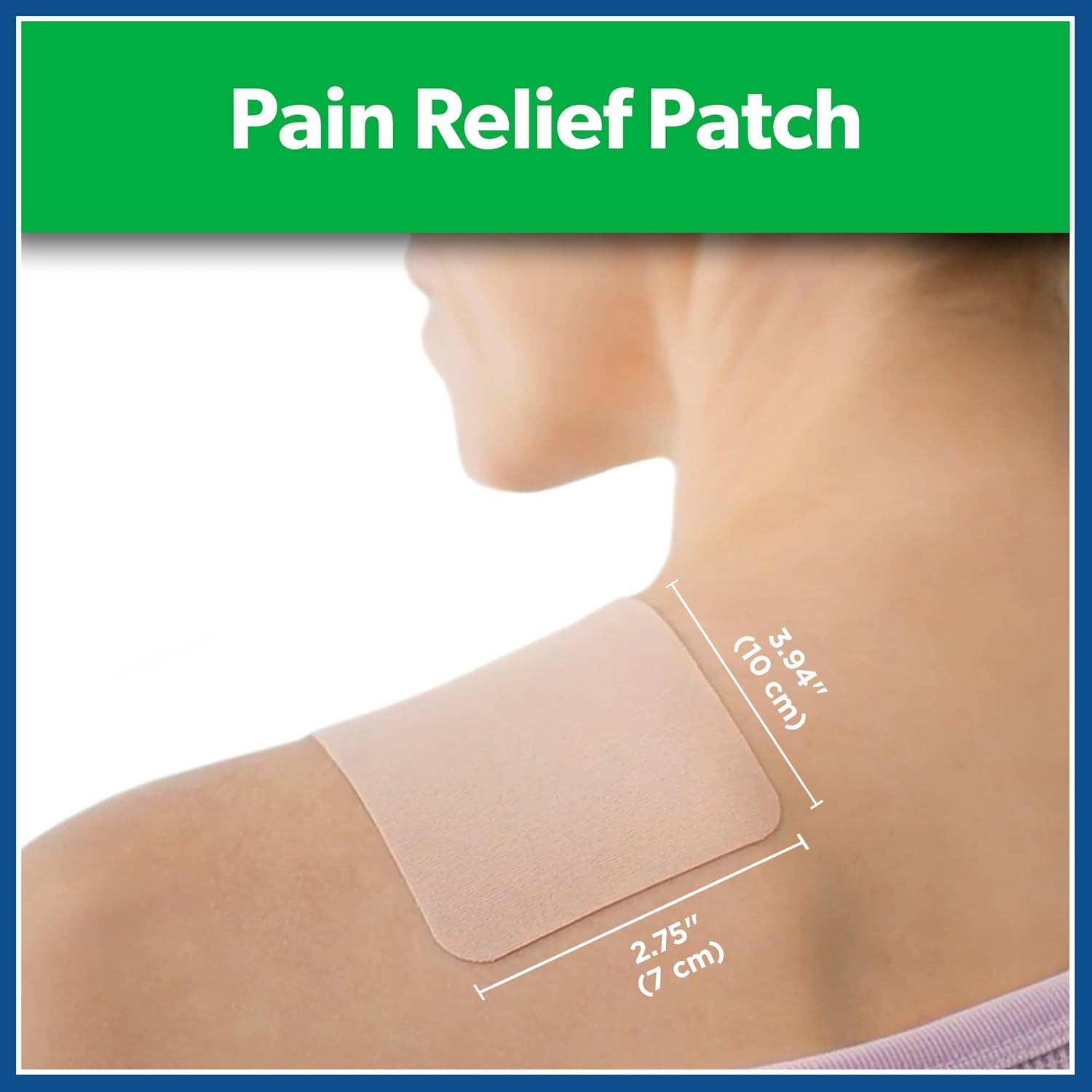
Salonpas
$18.19
In stock on Amazon
Check price on AmazonThe Numbers: Comparing Format Characteristics at a Glance
| Format | Active mechanism | OTC concentration range | Typical effective duration | Avg. cost per application |
|---|---|---|---|---|
| Lidocaine patch | Local anesthesia (sodium channel block) | 3.5–4% lidocaine | 4–8 hours | $2.50–$5.00 |
| Menthol patch | Counterirritant (TRPM8 activation) | 1.25–16% menthol | 3–6 hours | $1.00–$3.50 |
| Heat wrap | Thermotherapy (blood flow / spasm relief) | N/A (heat output) | 8–12 hours | $2.00–$4.50 |
Cost-per-application estimates based on mid-2026 retail and club-store pricing for standard-count packages. Clinic or bulk purchasing typically reduces per-unit cost by 20–35%.
Trade-offs You Need to Name Before You Choose One
If you’re advising athletes, clients, or staff — or stocking a training room — these are the actual decisions you’re making between formats.
Acute nerve-dominant pain vs. muscle-dominant pain. Lidocaine patches are strongest when the pain signal itself is the problem — post-procedure soreness, localized nerve irritation, or a sharp, well-defined ache in a small area such as a tender point in the IT band or a bruised rib. Menthol patches and heat wraps perform better when the issue is muscular: spasm, general stiffness, or the dull ache of overworked tissue. A narrative review on topical analgesics in sports medicine published through the National Center for Biotechnology Information (NCBI) confirms that athletes with predominant muscle-fatigue soreness report higher satisfaction with warming and counterirritant agents than with pure anesthetics.
Active vs. post-activity use. Heat wraps under compression clothing during activity is an established athletic-trainer practice for chronic low-back tightness. Menthol patches are also used pre-activity by some athletes as a warm-up adjunct — the sensation increases perceived readiness. Lidocaine patches before activity present a different risk profile: numbing pain signals is genuinely useful for recovery, but masking acute pain during activity can allow athletes to ignore injury aggravation. This is not a reason to avoid lidocaine patches; it is a reason to match them to the right window — post-training, recovery days, and sleep.
Skin sensitivity and wearability. Heat wraps are worn over clothing, so they carry no direct skin-contact risk for most users. Menthol patches carry a modest risk of contact irritation in sensitive individuals, especially at concentrations above 8%. Lidocaine patches carry the lowest counterirritant-driven skin irritation, but the adhesive layer on some formulations — particularly lower-cost generics — generates more reports of adhesive dermatitis. For clients managing eczema-prone skin or known adhesive sensitivity, heat wraps are the safest format choice, followed by menthol patches, with lidocaine patches requiring a patch-test on a small area of skin first.
Visibility and discretion. Practitioners in school or workplace settings hear this question more than they expect: what can a client actually wear without it being visible or raising questions? Heat wraps in back, knee, and wrist form factors sit comfortably under clothing. Thin hydrogel menthol patches in neutral or flesh-tone formats are similarly low-profile. Some lidocaine patches — particularly larger-format 4% patches designed for the lower back — are thicker and more conspicuous under athletic wear.
Regulatory and scope-of-practice notes. OTC lidocaine patches at 3.5–4% sit comfortably within lay use and athletic-trainer recommendation. Any claim that a lidocaine product treats a specific diagnosed condition — shingles pain or post-herpetic neuralgia, for example — requires the 5% prescription product and physician oversight. The Drugs.com monograph on topical menthol notes that menthol products should not be applied to broken or irritated skin and should be kept away from eyes and mucous membranes — practical guidance for anyone stocking a training room where athletes apply products themselves.
Decision Framework: Matching Format to Situation
You’ve reviewed the mechanisms and the trade-offs. Here is the clean decision logic for the situations that actually come up.
If the pain is acute, localized, and nerve-prominent — a specific tender spot, a bruised area, post-procedure soreness, or a sharp point-source ache — use a lidocaine patch. It addresses the signal at the source. Look for 4% lidocaine concentration; that is the practical ceiling in the OTC market as of mid-2026. Larger patches (4” × 5” or equivalent) give better coverage for lower-back and hip presentations.
If the pain is muscular, diffuse, or associated with tightness and the athlete is in an active or pre-active window — choose a menthol patch. It will not mask acute injury signals the way lidocaine can, it is familiar to most athletes who have used counterirritant gels or sprays, and the mechanism is well-documented in the FDA’s OTC monograph on external analgesics. For budget-sensitive buyers or high-volume training room use, menthol patches offer the strongest cost-per-application value in the format category.
If the presentation is chronic stiffness, deep-muscle soreness from heavy loading, or the athlete needs relief over an extended period — such as during sleep, a long travel day, or recovery between training sessions — a heat wrap is the right tool. The 8–12 hour effective window is unmatched by either patch format, and the thermotherapy mechanism addresses tissue-level causes such as reduced blood flow and muscle spasm rather than simply modulating the pain signal. For lower-back presentations in particular, Healthline’s heat therapy overview references controlled study evidence showing benefit for non-specific low-back pain with continuous heat application.
If you are stocking a facility and need one format that handles the broadest range of presentations — stock menthol patches as your everyday inventory and add lidocaine patches as a targeted secondary option. Heat wraps are better recommended for individual purchase given their single-use, bulkier format. Menthol patches cover muscle soreness, general aches, and active-use scenarios; lidocaine patches handle the subset of clients with localized acute pain requiring stronger signal interruption.
What to Look for on the Label
Regardless of format, three label details separate a well-formulated product from a marketing exercise.
Active ingredient concentration. It must be listed explicitly. “Maximum strength” means nothing without a number. For lidocaine patches, 4% is the functional OTC ceiling. For menthol, you want at least 5–6% for a noticeable therapeutic effect on muscle pain; products under 3% are primarily providing sensation, not meaningful analgesic relief.
Patch size and coverage area. Manufacturers frequently vary patch dimensions between lines without calling attention to it. A patch listed per-unit at a higher price may actually be delivering 40% more coverage — and better cost-per-application value — than a cheaper option in a higher-count box. Do the size math before defaulting to per-patch price.
Inactive ingredient list and adhesive quality. For anyone with adhesive sensitivity, look for hydrogel-based adhesives over synthetic acrylic adhesives. Hydrogel formulations consistently generate fewer dermatitis complaints across aggregated reviewer feedback. For athletes applying and removing patches multiple times per week, adhesive quality compounds quickly as a comfort and skin-health factor.
When to Send Someone to a Doctor
Pain-relief patches — all three formats — manage symptoms. They do not diagnose or treat the underlying cause of pain. If a client or athlete describes pain that worsens rather than improves over 48–72 hours despite appropriate patch use, radiates from the back down the leg or arm, is accompanied by numbness or weakness, follows a significant trauma, or is paired with fever or unexplained swelling, that presentation is outside the scope of any topical OTC product. The right recommendation at that point is clinical evaluation, not a stronger patch. Keeping this boundary clear is what makes any OTC recommendation credible.
The Mayo Clinic’s topical lidocaine overview and the Drugs.com menthol monograph both note explicitly that topical anesthetics and counterirritants are appropriate for minor, temporary pain management — not for ongoing or undiagnosed pain conditions. That context belongs in every practitioner’s recommendation conversation, whether you are advising a single athlete or setting policy for a training facility.