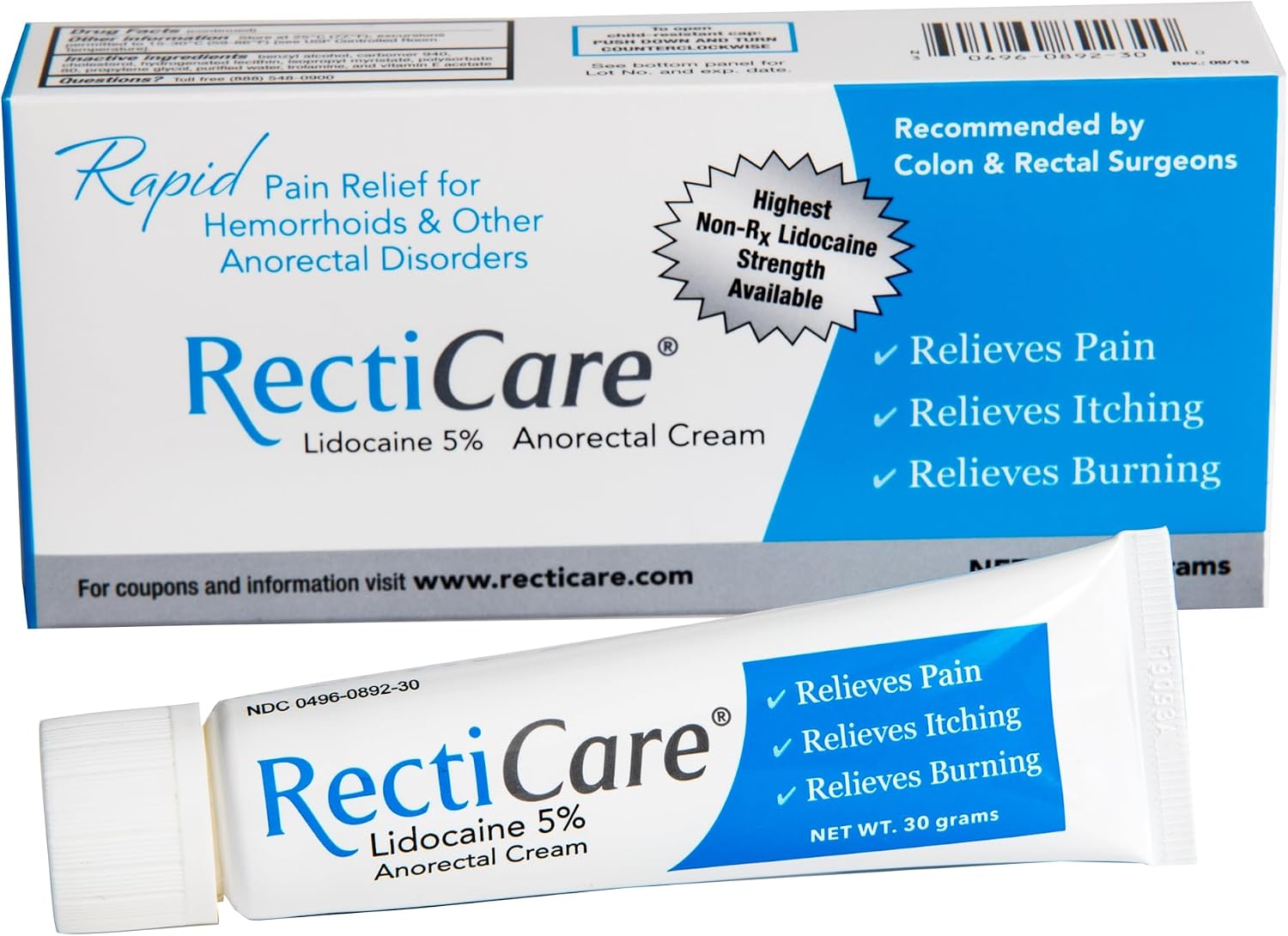
Hemorrhoids — swollen veins in or around the rectum and anus that cause itching, burning, and sometimes sharp pain — affect roughly three out of four adults at some point in their lives, according to the Mayo Clinic’s hemorrhoid overview. For most people, the discomfort is manageable at home with an over-the-counter (OTC) topical numbing agent. Lidocaine is the active ingredient you’re looking for: it’s a local anesthetic (a substance that temporarily blocks nerve signals to reduce pain and itching) that works within minutes when applied to the skin surface. Most drugstore hemorrhoid products max out at 2.5% lidocaine concentration. The 5% formulations are a different category — higher potency, longer effective window, and a meaningfully different cost-per-application profile. If you’re evaluating products for a home health caseload, a physical therapy or sports-medicine office that stocks patient-facing supplies, or your own well-researched medicine cabinet, this guide gives you the comparison framework to make the right call.
| EDITOR'S PICK[Zensa Numbing Cream 5% Lidocaine](https://www.amazon.com/dp/B01B14NDGQ?tag=greenflower20-20) | Mid-tier[RectiCare Anorectal Lidocaine 5…](https://www.amazon.com/dp/B0085A32G6?tag=greenflower20-20) | Budget pick[Nivagen Maximum Strength Lidoca…](https://www.amazon.com/dp/B0829G4L4D?tag=greenflower20-20) | |
|---|---|---|---|
| Format | Water-based | Cream | — |
| Additives | Vitamin E | — | — |
| Lifestyle | Vegan, Cruelty-free | — | — |
| Target | — | Anorectal disorders | Anorectal |
| Hypoallergenic | ✓ | — | — |
| Price | $39.99 | $24.89 | $17.99 |
| See on Amazon → | See on Amazon → | See on Amazon → |
Why Concentration Actually Matters — and Where 5% Sits in the OTC Landscape
The FDA’s External Analgesic OTC Monograph (the regulatory document governing what ingredients and concentrations are allowed in non-prescription topical pain products) permits lidocaine at concentrations between 0.5% and 4% for general external analgesic use on intact skin. For anorectal (hemorrhoid-specific) use, the monograph allows up to 5% lidocaine — a ceiling that exists because the perianal tissue is highly vascular and absorbs topicals more readily than, say, the forearm.
That ceiling matters in two directions. First, it means 5% is genuinely the highest concentration available without a prescription for this application — there’s no meaningful “more potent” OTC option to trade up to. Second, it means systemic absorption (the amount of lidocaine that enters the bloodstream) is a real consideration at this concentration, which is why Drugs.com’s lidocaine topical monograph explicitly flags that the perianal area carries higher absorption risk than most other skin sites. For healthy adults using appropriate amounts, this is a minor concern. For patients managing hepatic impairment, cardiac arrhythmia history, or infants and young children, the practitioner-level conversation starts here.
The practical upshot: 5% lidocaine offers a faster, deeper numbing effect compared to the 2–2.5% products that dominate the hemorrhoid shelf. Published pharmacodynamic data cited in NCBI’s review of topical anesthetic mechanisms suggest that doubling concentration does not simply double effect duration, but it does meaningfully lower the time-to-onset and raises the ceiling for severe acute pain management. For someone managing a thrombosed external hemorrhoid — one that has developed a blood clot and produces sharp, acute pain — the difference between 2% and 5% is clinically perceptible.
Vehicle Analysis: Cream vs. Ointment vs. Gel
Concentration is only half the equation. The delivery vehicle — the base that carries the lidocaine to the tissue — determines how quickly the drug releases, how long it stays put, and how comfortable the application experience is. For anorectal use, this isn’t abstract.
Cream vehicles are water-in-oil or oil-in-water emulsions that spread easily, absorb relatively quickly, and leave a lighter residue feel. They’re generally preferred for daytime use and by people sensitive to the greasier feel of ointments. The tradeoff is a somewhat shorter effective window because the base doesn’t occlude (seal in) the active ingredient as aggressively.
Ointment vehicles use a petrolatum or oil-continuous base that stays on the surface longer, creates a mild occlusive barrier, and extends the effective contact time between the lidocaine and the tissue. Pharmacy Times’ review of OTC topical anesthetics notes that occlusive bases meaningfully increase dermal penetration of lidocaine, which is relevant when you want sustained relief through a night’s sleep or a long work shift. The cost: ointments feel greasier, can transfer to clothing, and may be less tolerable for people with sensitivity to petrolatum-derived ingredients.
Gel vehicles offer the fastest perceived absorption and the cleanest feel, but the rapid diffusion can also translate to a shorter effective window. In a hemorrhoid context, gels tend to show up in combination products or in professional-procedure prep rather than standalone hemorrhoid management.
The practical decision rule for vehicle:
- Acute, severe pain → ointment base (maximum occlusion, longest effective window)
- Daily management, active lifestyle, daytime use → cream base
- Procedure prep or one-time use → gel acceptable
If you’re stocking for a home health caseload with diverse patient profiles, carrying both a cream and an ointment formulation in 5% concentration covers the full use-case range without overstocking.
Cost-Per-Application Math: How to Compare Across Pack Sizes
Price-per-unit on the shelf is a trap for volume buyers. What you actually need is cost-per-application, which requires knowing the recommended dose per application and the total net weight.
The standard OTC dosing guidance for anorectal lidocaine products is approximately 1–2 grams of product per application, up to four times daily. Most labeled usage is a “pea- to fingertip-sized amount” for external application, which typically runs 1–1.5g per use for external hemorrhoid management. Rectal applicator use (for internal hemorrhoids) consumes more per application — typically 2–4g.
By the Numbers — Example Cost-Per-Application Calculation:
| Package Size | Typical Retail (2026) | Doses @ 1.5g/application |
|---|---|---|
| 28g (1 oz) tube | ~$12–$16 | ~18 applications |
| 57g (2 oz) tube | ~$22–$28 | ~38 applications |
| 113g (4 oz) clinic jar | ~$38–$52 | ~75 applications |
At those midpoint prices: the 1 oz tube runs roughly $0.78/application; the 4 oz clinic jar runs roughly $0.60/application. That’s a 23% cost reduction per application at clinic-pack volume — meaningful when you’re stocking for a home health agency running 20+ active clients.
The NCBI pharmacology literature is consistent that with occlusive ointment bases, some practitioners can achieve adequate effect with slightly smaller application volumes, nudging the clinic-pack advantage higher. But don’t build your purchasing model on using less than labeled — that introduces compliance inconsistency in a supervised-care setting.
Tradeoffs Worth Naming Explicitly
Because this is a buying decision with real clinical and financial stakes, here are the tradeoffs that often get glossed over in product descriptions:
Higher concentration ≠ always better for every user. The FDA monograph permits 5% for anorectal use, but also notes that this concentration should not be applied to broken, bleeding, or severely irritated tissue without medical guidance. For patients with active fissures or post-surgical anorectal wounds, a 5% lidocaine cream is not an appropriate self-care OTC choice — that’s a clinical consult, not a product recommendation.
Combination products dilute the concentration comparison. Many branded hemorrhoid products pair lidocaine with a vasoconstrictor (typically phenylephrine, which reduces swelling by constricting blood vessels) or a skin protectant (zinc oxide, white petrolatum). These combinations can be clinically useful — the vasoconstrictor addresses the swelling component that lidocaine alone doesn’t touch — but they complicate direct lidocaine-concentration comparisons. A 5% lidocaine-only product and a “maximum strength” combination product with 2% lidocaine plus 0.25% phenylephrine are not the same thing, and one is not simply “stronger” than the other across all symptom dimensions.
Shelf life and storage matter at clinic scale. Lidocaine is relatively stable, but cream and ointment bases can separate or degrade with temperature cycling. If you’re storing in a vehicle, a gym trainer’s bag, or an outdoor-adjacent clinic space, the 12–24 month shelf life printed on the tube assumes stable room-temperature storage. Buying a 6-month supply of 4 oz jars only saves money if utilization actually tracks the expected pace.
Generic vs. branded formulation. Major branded hemorrhoid lines invest heavily in packaging and marketing, but the FDA requires generic OTC products to use the same active ingredient at the same labeled concentration. Per the FDA OTC monograph framework, a store-brand 5% lidocaine ointment is required to deliver the same active pharmaceutical ingredient as a nationally advertised 5% product. The vehicle (base) is allowed to differ between generics and branded products, and this is where review-based evidence matters: reviewers and clinicians who have used both often cite texture, ease of application, and applicator design differences — none of which change the active-ingredient performance, but all of which affect adherence and patient satisfaction.
When OTC 5% Lidocaine Is Not the Right Tool
Building credibility in a clinical or semi-clinical context requires naming the limits clearly. The Mayo Clinic’s hemorrhoid treatment overview and the FDA’s OTC analgesic monograph both draw the same boundary: OTC topical anesthetics are appropriate for symptom management of mild to moderate external hemorrhoids. They are not appropriate as a substitute for evaluation when symptoms suggest:
- Significant rectal bleeding (more than minor spotting)
- Symptoms persisting beyond 7 days without improvement
- Severe pain inconsistent with hemorrhoids (which can indicate fissure, abscess, or other anorectal pathology)
- Any hemorrhoid symptoms in patients under 12 years old without physician guidance
- Use during pregnancy or nursing without a provider’s sign-off, given the higher systemic absorption profile of perianal tissue
This isn’t liability boilerplate — it’s the practical frame that keeps the 5% lidocaine conversation honest. If the patient you’re serving is cycling through multiple tubes without relief, the product isn’t the variable worth optimizing.
The Decision Framework: If X, Then Y
To make this concrete:
If you’re a home health aide or small-practice buyer stocking for routine external hemorrhoid symptom management across a mixed adult caseload → prioritize a 5% lidocaine ointment in a 4 oz clinic-size format from a brand with a documented petrolatum-based vehicle. The cost-per-application advantage at clinic scale is real, and the ointment vehicle gives you the occlusion profile appropriate for overnight relief.
If you’re an individual buyer managing acute symptoms with an active daytime schedule → a 5% lidocaine cream in a 1–2 oz tube balances potency with application comfort. The cream vehicle is more practical for daytime use and doesn’t require explaining the grease transfer issue.
If the patient profile includes active bleeding, post-procedure recovery, or immunocompromise → this is a “see a clinician first” situation before any OTC lidocaine recommendation, regardless of concentration or vehicle. Per Drugs.com’s lidocaine topical monograph, these are the conditions where the absorption risk profile changes enough to warrant a professional assessment.
If cost-per-application is your primary variable for a high-volume setting → run the calculation above with actual current prices from your preferred distributor. The math is not complicated, but it must be current — pricing in this category has seen moderate upward pressure in 2025–2026 with supply chain adjustments in API (active pharmaceutical ingredient) sourcing.
The 5% lidocaine tier is a legitimate tool with a clear clinical rationale. It just requires knowing which vehicle fits the use case and whether the price-per-application math actually pencils out at your purchasing volume. Neither of those is a hard problem once you have the framework — which you now do.